From Valve Seats to Raptors
When John Inglis founded Exactaform Ltd in 1979, he was a one-man operation making carbide tooling for the automotive industry. Today, the company employs over 100 people, serves more than 500 customers across four continents, has created upwards of 30,000 unique tools, and is widely recognised as one of the UK’s leading independent PCD tooling manufacturers. Central to every chapter of that growth has been machine tools from Vollmer.
When John Inglis speaks about growth and the corresponding investment in Vollmer machines, he speaks in the language of multiplication. "The first Vollmer machine was a calculated risk with significant financial borrowing that brought sleepless nights, but then came hard-won contracts. But machine one suddenly earns you X, and the second machine earns X times two. That gives you enough money to buy the third, and three machines then earn X times four." The first Vollmer QWD760 wire erosion machine landed in December 2000, and the innovation and automation set Exactaform on its way. Now, the Coventry manufacturer supports supply chains for global OEMs across aerospace, automotive, and high-performance engineering sectors.
The catalyst for the first Vollmer was practical rather than strategic. A high-volume engine programme required CBN tooling for valve seat machining — sintered high-speed steel in exhaust applications that conventional carbide tooling could not handle economically. That introduced Inglis to superhard materials at production scale, and the implications became clear. "I soon realised there was a call for PCD tools, but there was a problem with grinding PCD — we recognised automation, and Vollmer was the way to go."
The First Gamble
Prior to the first Vollmer machine, Exactaform evaluated a range of wire EDM technologies. However, it was the first Vollmer metalworking machine in the UK, the Vollmer QWD760 wire erosion machine, that started the success story. Still running today, that first Vollmer machine was the point that Exactaform formally diversified into rotary PCD tooling – and then purchased a Vollmer QWD755H, the X times two machine that was the foundation stone for aggressive growth. “At the time, it was a gamble. But the gamble paid off. Once you get your head round it, it just grows and grows and grows," says Inglis.
On The Wire
The logic of multiplication took hold quickly. A second QWD760 was added, and another two QWD750H machines arrived in January and March 2008, bringing robotic loading and genuine lights-out production capability. A further QWD750H followed in October 2009. The QWD750H machines transformed how Exactaform operated. With 12-station carousel loading, the QWD machines could be set at the end of a shift and left to run unmanned through the night, each cutter taking anywhere from 45 minutes to three hours to machine.
"The QWDs would run an average of 120 hours a week, every week," Inglis notes. "When busy, we have run the Vollmers for 160 hours out of a possible 168 hours in the week — the remaining eight hours used for wire changeovers." A single operator could oversee an entire bay. "We could load the machines and just walk away." Further QWD750H additions followed in August 2011, February 2012, December 2012, and December 2013. By the time the wire erosion fleet reached its full complement, one operator per shift was running what amounted to a fully automated PCD finishing line. This uptick in fortunes was driven by a pivot from the automotive industry to the aerospace sector.
The Aerospace Breakthrough
It was against this backdrop of automated production and expansion Exactaform made a decisive move into aerospace in the mid-2000s, driven by the growing demands of carbon fibre machining. It was defeating standard carbide tooling, and PCD offered decisive advantages.
The work within a major UK aerospace programme opened further doors. Inglis was invited to a US military OEM weapon facility, expecting to meet an engineer. He found himself in an auditorium facing 30 engineers. "They asked me to explain why our method was better than theirs on the latest fighter jet," he recalls. "They were still using carbide, and it was taking forever. The result was a significant first order, followed by further adoption across additional programmes. It rapidly spread around the world."
The demands of aerospace sharpened every aspect of the business. Carbon fibre machining requires tools that minimise delamination and control cutting forces precisely. Exactaform invested in a dynamometer table to measure both downward and rotary cutting forces during trials, enabling the development of tool geometries to reduce cutting forces and extend tool life. "That was the real breakthrough. Some engineers say our tooling is like polished jewellery."
Aerospace is now about 40% of Exactaform's business, and the company works with the European subsidiaries of the world’s most prominent commercial and defence aerospace OEMs and Tier 1’s. "Once you can get on the quoting list, it can be massive in some cases," Inglis adds.
Raising the Speed
As wire erosion capacity grew, a different challenge emerged. The QWD machines were highly effective at profile finishing, but cycle times were fixed regardless of how much material needed to be removed. For high-volume finishing, a different solution was needed. Vollmer had the answer with the QXD200 rotary erosion machine.
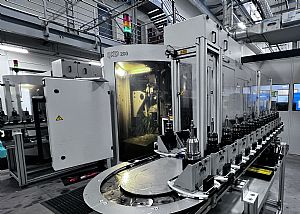
The first QXD200 arrived in January 2009, accommodating 12 cutting tools and up to six grinding wheels simultaneously across six controlled axes — measuring, eroding, grinding and polishing in a single set-up. Tolerances of 0.001mm were achievable, with repeatability within 5 microns. The results were immediately compelling. A second QXD200 followed in January 2011, this time with a 29-tool changer for larger unmanned batch runs. Two more QXD200 machines arrived in February and September 2012, and the series concluded in May 2014 with a QXD250 for more complex profiles.
You Can’t Make It If You Cannot Measure It
Exactaform has also built substantial metrology capability, with every one of the 7,000 PCD tools produced per month being 100% inspected before dispatch. PCD requires optical inspection and the company uses Helicheck systems for full optical measurement of all tool geometries. "You can't manufacture it if you can't measure it," says Inglis.
The inspection commitment underpins the commercial model where 80% of Exactaform's output is bespoke — customers supply a component drawing, not a tooling drawing, and Exactaform designs, manufactures, trials and delivers the solution. Over the company's history, more than 30,000 unique tools have been created in this way. "We produce the tools to machine their part so they don't have to do any engineering," says Inglis. "They just give you a component drawing and ask: how do we machine that? Can you do it quicker than the other guy?"
Carbide, the VGrind, and the VHybrid
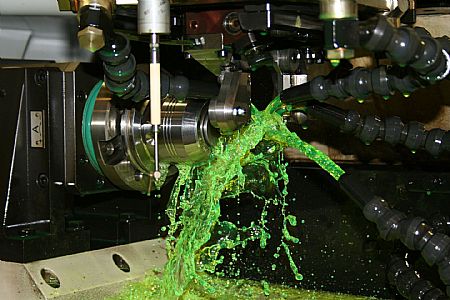
The next chapter of Exactaform's Vollmer investment began in September 2016 with the arrival of the first VGrind — Vollmer's 5-axis CNC grinding centre for solid carbide tools. A coolant filtration FC-250W unit followed a month later, supporting the precision fluid management that carbide grinding demands. A second VGrind 360 arrived in September 2019, extending carbide grinding capacity as the product range broadened.
The strategic logic is clear. As carbide raw material prices have surged, the relative economics of PCD have improved. Rising carbide costs make re-tipping in diamond increasingly attractive to end users. "We can tell customers that for the price they pay for carbide, we can re-tip the tool in diamond and offer huge productivity and tool life enhancements," says Inglis. The carbide-to-PCD split, previously around 80/20, has moved progressively towards 70% PCD, 25% carbide, and 5% accessories — holders, adaptors, and complementary tooling components.
In February 2024, the most complex machine in the UK fleet to date arrived: a VHybrid 260 paired with a Vomat filtration system. The VHybrid combines disc erosion and precision grinding in a single machine, enabling PCD and carbide tool processing within one set-up. The primary application was drills. "Horses for courses," says Inglis. A second VHybrid has been ordered for the Tennessee facility, where the Exactaform USA operation already runs two converted UK Vollmer machines on American specification.
Growth and Acquisitions
In 2017, Exactaform moved into a purpose-built 42,000sq/ft² facility in Coventry — a three-stage process of relocation, machine investment, and R&D expansion that the company's management describes as planned, not opportunistic. By 2023, the group had taken a further step, forming an aerospace consortium through three acquisitions that broadened both its capability and its customer access within the sector. Today, under Managing Director Jamie White, the group employs over 130 people across its UK and US sites, with the Tennessee manufacturing facility having opened in 2022. The 2024–2025 investment programme, which includes both the VHybrid and the VPulse 500, reflects the current phase: capability-led growth, focused on people and equipment in equal measure.
Closing the Circle
In May 2025, Exactaform took delivery of a Vollmer VPulse 500, Vollmer's wire erosion platform for PCD tooling, representing the latest generation of technology. The VPulse 500 achieves unprecedented levels of precision and efficiency. With its new erosion generator, maximum reliability and ease of operation, as well as various automation options, the possibilities for round-the-clock high-efficiency automated operation are endless. Now, the family-owned business has a full complement of Vollmer technology with wire and rotary erosion, carbide grinding and hybrid processing - the circle is complete.
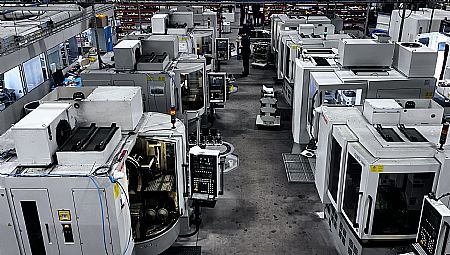
Exactaform is a business continually growing, built on a foundation of process investment that includes 21 Vollmer machines purchased over 25 years. Skills shortages remain a genuine industry challenge, but automation continues to extend what each operator can manage. "Buying the right equipment is very important," says Inglis. "If you haven't got the right equipment you’re in trouble — that's why we went for Vollmer’s."
From early automotive applications to today’s role within global aerospace supply chains, Exactaform's story is one of compounding investment and capability.